There Is No Easy Path

I just watched the movie “The Secret”, and my oh my was I disappointed in both the creators and the supporters of this movie. The movie basically takes the simple concept of “stay positive, be passionate about what you desire, and apply yourself to find ways to achieve your desires” and drags it out into a ridiculously long movie that claims all you need to do is wish for something and it will come true. No further detail went into explaining how this miraculous event occurs, instead they just gave ludicrous examples of “the secret” in action.

I couldn’t be more saddened by the fact that some people believe this is true. Sure, wishing and hoping for something is one step towards achieving a goal, but it’s just a single baby step towards reaching that goal. If you really want something, you need to commit yourself to it. Wishful thinking alone is for bums. Being positive and hoping for a better tomorrow certainly doesn’t hurt your circumstances, but actually applying yourself and thinking of ways to reach your goals is a much better plan.

I think of how many products and services surround our society that promise amazing results with little to no effort required. It’s just sad to know there is always a sucker out there willing to hand over their money in return for false hope. Especially when it comes to investing. The Investing industry is full of lies, with scam artists hoping they can convince you that they have the secret for profitable investing. Too many discouraged, ignorant, or foolish investors keep these useless companies in business by believing their lies and purchasing their product or service.

Well, I’m here to say one thing: There is no easy path. The average individual needs to wake up and realize that success is achieved through becoming knowledgeable, working intelligently and diligently, staying committed, staying positive, and believing in yourself. Wishful thinking alone will take you nowhere, especially in the stock market. The sooner you realize this, the quicker you can move on to the proper ways of learning how to achieve your goals.

5 Ways to Invest Without Emotion

Emotions are the handicap of the novice investor. They hinder your rational thought process and increase your chance of failure. So it should be obvious that you’ll need to ignore your emotions if you ever want to make a profit while investing. Here are some quick ways you can become as cold as ice and invest emotion-free.

1. No Wishful Thinking
There is no stock genie granting magical wishes. If your stock is performing poorly, you need to get straight to the point and ask yourself why you are still invested in your stock. If your answer is anything other than “I know for certain that the market is valuing it incorrectly”, then you are just doing wishful thinking.

2. Take a Time Out
If you feel like you aren’t certain what you should do with a stock, and that perhaps you are becoming emotional, then you need to take a time out. Step away from your desk, try and go to a quiet place, and remind yourself why you are investing in your stock. If your explanation sounds rational to you, then you know you are invested properly. Use this to boost your confidence anytime you doubt yourself or become emotional.

3. No Playing Favorites
It’s easy to grow fond of a stock that has made you a good profit (or still is making you profits). While it’s okay to be a supporter of the company the stock represents, it’s not okay to blindly put your money into it hoping their past performance will continue. Always remember that you invest in stocks to make money, and nothing more.

4. Don’t Obsess Over Daily Fluctuations
If you are investing and not trading, you need to realize that your stock’s price will fluctuate every day. This is normal, and it shouldn’t change any of your beliefs on where the stock is headed, unless there is a significant change that occurs within the stock.

5. It’s Just Money, Get Over It
This might seem crazy to some, but you should always remember that in the end it’s just money. If you obsess over your profits and losses, you’ll be investing with a clouded mind. Part of being an unemotional investor is accepting the fact that you will sometimes lose money. As long as you pick yourself back up and head right back with a rational thought process, you’ll almost always come out profitable.

Book review: Rich Dad, Poor Dad

Rich Dad, Poor Dad by Robert T. Kiyosaki

Rating: 5/5, A must read book

Investor, businessman, motivational speaker, and author Robert Kiyosaki wrote an instant classic with his book “Rich Dad, Poor Dad”. In it, Kiyosaki describes the unique difference in perspectives between his poor father and his best friend’s rich father. The book explains why the average middle class person is usually financially troubled even if they are highly educated and work hard, driving home the idea that the poor work for their money, while the rich make their money work for them. Kiyosaki goes on to explain why it is so important to build assets and get rid of your liabilities.

Many people are quick to argue that the book’s failings are in that it doesn’t give specific applications to build your wealth. However, I think the people who argue this missed the entire point of the book. Kiyosaki’s intention for the book wasn’t for it to be a literal guide to building wealth, but rather to inspire you to find your own means of building wealth. Kiyosaki constantly reiterates thoughout his book that you should always attempt to find new ways to accumulate assets that will make you money.

I found the book to be very inspiring and enlightening. The book was slightly repititive, but I believe that was done intentionally so the author’s message would stick with his readers. I highly recommend reading, if not purchasing this book. It also makes a good gift for anyone you think needs financial guidance.

5 Traits of Every Successful Investor

Successful Investors

Every investor has their own strategies, methods, and techniques to achieving success. Though despite these differences, all successful investors share the same distinct traits which truly separate them from the herd. The five traits of a successful investor are:

Highly disciplined and committed

Discipline is the backbone of a successful investor. Being highly disciplined means you are committed to your efforts so that you are always prepared. If you want to be successful in the stock market, you need to commit to it. There is no such thing as a free lunch. Successful investors don’t let the hurdles such as previous investing failures get in their way, and neither should you. If you know how to invest properly, discipline and commitment will ultimately be your gateway to success.

Invests without emotion

Emotions are the handicap of the novice investor. Successful investors know that rational investing is fundamental, so they disregard their emotions while analyzing their investments positions, decisions, and ideas. If emotions are thrown into consideration while investing, the thought process of a rational investor becomes clouded and often leads to failure.

Always up to date with the market

A funny thing about the stock market is that everybody has the same information, but everybody interprets it differently. Successful investors are always up to date about the current market by using unbiased financial media sources to get their information. The stock market is full of variables that can drastically influence market prices, so staying on top of those variables is crucial.

Possesses a realistic outlook on investing

Having a realistic outlook on investing and success coincides with being highly disciplined and committed. Successful investors understand that they probably will not become the next Warren Buffet, by which I mean they won’t make astronomical returns on their investments. However, humble expectations often lead to high returns, as an investor without excessive greed will have a clear state of mind and will invest properly.

Always has a plan

Not having a plan while you invest is like a coach telling his players “Just go out there and win”. Sure, if you’re lucky and/or naturally talented enough, you might make a few successful investments, but this plan (or lack of) hardly is effective in the long term. Successful investors understand the importance of having a plan. They know where they want to get in, where they want to get out, what they will do if something changes or goes wrong, and what their goals ultimately are. Having a plan keeps an investor focused so that they will stay rational while they invest.

Introduction to the Stock Market

The Stock Market is a significant entity of our society that seems to have too much ignorance surrounding it by the non-investing individuals. The intention of this mini-series entitled “Introduction to the Stock Market” is to enlighten the average individual with no background or knowledge in the investing world.

What is the point of the stock market? Why do companies sell shares?
The point of the stock market is fundamentally simple, but can often be complicated in today’s conditions. In it’s simplest form, the point of the stock market is for companies to sell a portion of their company in the form of shares to raise money, and investors purchase shares to receive a portion of the company’s profits relative to the portion of shares they purchased. Of course, this description of the stock market hasn’t been accurate for decades…

While most companies’ reason for going public and selling shares of their company is still to raise money that will be reinvested into the company, some companies now go public for the sake of extracting the worth of their company. This usually occurs in an overbought stock market where IPOs are a hot commodity. In other words, sometimes companies go public just to ride good momentum in the stock market and never plan to reinvest the raised money into their own company.

Fortunately most informed investors are aware of this technique used by underachieving companies, so this has never been much of a issue. The investor’s goal in the market is to grow his wealth, but that goal is now fulfilled by more than just dividends. The old adage of buy and hold is no longer relevant in today’s market. In fact, many major public companies don’t even provide dividends to their shareholders. These companies prefer to reinvest their extra cash in the company for growth purposes, than to pay their shareholders their portion of the profits. So in the current market, the investor’s purpose is to grow his wealth through any way possible (as long as it’s legal). Methods of growing wealth include buying long, selling short, speculation investing, dividends, etc.

Who or What steers the Stock Market?
The list of variables that streer the stock market are practically limitless, but the most influential and significant factor in determining the direction of the stock market is the economy. In general, the stock market and the economy move in a positive relationship (when the economy is up, the stock market is up and vice versa), but this is not always the case.

Often times the confusion and/or irrational exuberance of investors leads to an unusual relationship between the stock market and the economy. By unusual, I mean that it is possible for the economy to have completely different characteristics in terms of growth than the stock market. For example: the economy can be stagnant with no signs of growth, meanwhile the stock market is rallying upward. Another example: the economy can have moderate growth, but the stock market can be declining downward. The reasons these unusual relationships form are best left for the more advanced articles you can find on this website.

The Definition of an Investor

Most people would argue that you’re either an investor or a trader. However I would argue that an investor can possess characteristics of a trader while still maintaining the core attributes of an investor. The definition of an investor or trader shouldn’t be relative to a time period. If you invest in a stock for only a few days, this shouldn’t mean you are automatically a trader.

If your original purpose was to purchase shares in a company to achieve a good percentage return on your investment, but this goal was reached in a short period of time and you sold your shares, all this makes you is a quick investor. Not a trader. A trader by my definition is someone who looks to solely play the momentum of a stock in their favor and use tools such as technical analysis to find reasonable entry and exit points in a stock.

However, my definition of an investor is someone who looks at the fundamentals of a company, considers outside market variables, and sees potential for good returns on his investment. The time it takes to achieve the returns is irrelevant. What is important in distinguishing an investor from a trader is that an investor is looking for his profit regardless of how long it takes to achieve it, as long as it is the best placement for his money to grow.

Please note that I have nothing against traders. Trading just isn’t my style. I prefer to invest instead of trade because it helps me sleep better at night. Just kidding. Although there’s some truth in that statement.

How to Avoid Stock Market Corrections and Crashes

It is important when viewing this article to keep in mind that no one can truly know if and when a stock market correction or crash will occur. However, it is entirely possible to spot the signs of a coming correction or crash, and this article will show you how to assess the current market to help you decide whether you should stay in the market, short the market, or stay out of the market.

Spotting signs of a potential stock market correction or crash is a relatively easy task if you understand basic economics and if you are keeping up with the market on a daily basis. However, if neither applies to you, look for a combination of most, if not all of these signs as indicators of a potential stock market disaster (these signs by themselves aren’t enough reason to expect market declines):

Fundamental Problems Exist in the Economy
The Dotcom bubble in the late 90’s came to a hard crash after it became apparent that the hype of the online business models were not successful. The Dotcom bubble is a perfect example of a significant fundamental problem that once existed in the economy but was ignored by the stock market as it rallied higher. During the Dotcom bubble, the stock market rallied significantly as investors couldn’t get enough of the internet companies. The problem was that most of these companies weren’t profitable, some never intended to be either, choosing to ride the momentum of the stock market to make the most amount of cash they could off their stock. So while the stock market soared, our economy told a different story. If you observe fundamental problems in the economy while the stock market itself is rallying, be wary of a potential correction or even possibly a crash (although a crash seems unlikely).

Extended Amounts of Violent Volatility
If you are noticing high levels of volatility in the stock market for an extended period of time, this is a clear indication that something is wrong in the stock market. High volatility is nothing unusual by itself, and can arguably be considered healthy for the stock market. However if the stock market is experiencing see-saw like volatility (for example: one day the market rallies and the next day it plummets) for long periods of time, such as over a month’s time frame, then this is a sign there is too much confusion and confliction about which direction the stock market is heading.

Financial Media Reports Only Noise
If it seems like all you read or hear lately from the financial media is how our economy is in trouble, how there are serious underlying issues that need to be addressed, etc., then you are listening to what is known as noise. When you notice that the financial media has nothing but noise-like information to report for extended periods of time, then fear and instability get planted into the stock market. This relates with the psychology of investing, and it is important because a market that has seeds of doubt planted into it make it a fragile market, easily capable of correcting or crashing.

Unjustified Stock Market Prices
Identifying this sign does require knowledge of market prices, but you can simplify this and look at how high the three most popular indexes are (Dow Jones Industrial Average, NASDAQ, S&P 500). Read statements from the Federal Reserve and respected market analysts, and consider what our economic forecast for the year is. Ask yourself, how much has our economy grown so far in comparison to our stock market. Is there an inverse relationship? Should the market be at these high prices? If the answer is no, you know that the stock market can drop much lower than it can rally higher. Thus your risk is much higher than your reward. More about the risk versus reward will be discussed further in the article (yeah, it’s a long one).


Now that you’ve learned the technique to identify a fragile and correction/crash prone stock market, you now need to learn how to decide what your best plan of action is to be. If you read my other article “The Fundamentals of Successful Investing“, you know that having a plan is crucial. Even more so than usual, as a plummeting stock market catches most investors by surprise, so they have no plan to escape the chaos and ultimately fall victim to their emotions. This is arguably one of the reasons why panic selling occurs during a stock market correction and leads to a crash.   You have three basic decisions after you’ve reached your conclusion on the market, you can either:

1. Short sell the market
2. Buy long or stay long positioned the market
3. Sell your positions, stay 100% in cash and wait for a good re-entry point

So the question becomes, which move is the right one? To rationally consider the best choice of action, attempt to envision all of the problematic variables in the stock market. What could go wrong, what could go right, and what is realistically going to happen. If the potential risks of your plan of action outweigh the potential rewards of your plan of action, then you should reconsider. Remember, the key to successful investing is using a rational approach to form opinions of the market. If you know you’re putting yourself more at risk than you are at reward, you aren’t being rational.

If you find that the potential risks and rewards are about the same, then you should stay out of the stock market. When you can’t make a good decision because the stock market’s future looks too open to speculation, then there is no reward, just risk. Staying in a market that realistically could go either way (up or down) is not investing, it’s gambling. How can you have a plan of action when you aren’t even sure which way the market will go? The answer is to stay out of the market, and wait for a clear sign that the confusion has ended, and it is time to re-enter the market.
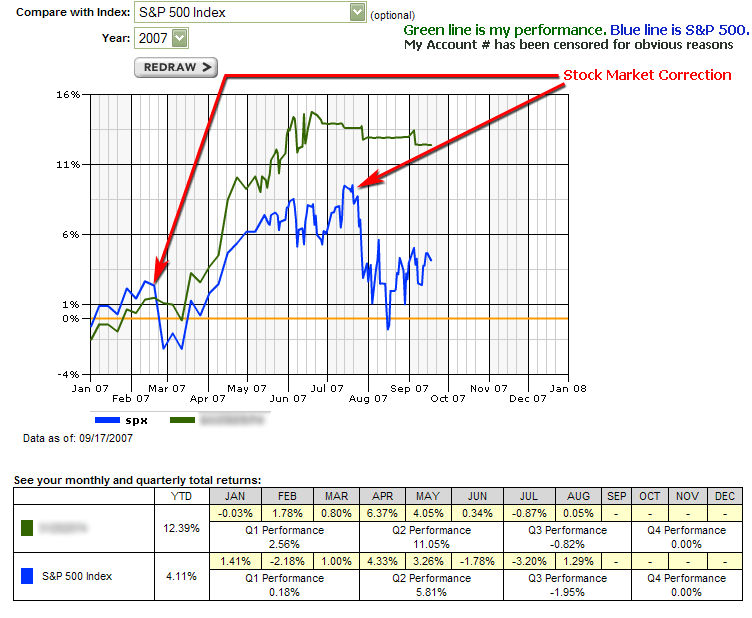

Walk the Walk, not just talk the talk. The techniques posted in this article are strategies I developed over time. Using these techniques I was able to avoid two stock market corrections in 2007. Here is a picture I took off my E-Trade account showing my performance versus the S&P 500. Note the stock market corrections that occurred and the performance of my portfolio not being affected. Click the image to enlarge it.


The Risks of Penny Stocks

Risks of Penny StocksThe investing industry is one that is plagued with a history of deceit. Fortunately for the average investor, the Securities and Exchange Commission is there to protect us from these deceitful companies. Public companies that you can invest in are required to report important documents of information to the SEC so that this information is public and there is transparency in the market. Without this requirement, public companies could claim they have high revenues when they don’t, and anyone invested in that deceitful company would find their stock worth nothing when it became known that the company is just a shell, producing little to no revenue. If this sounds scary to you, then this is exactly what you’re getting when you invest in penny stocks!

Penny stocks exist on a different market exchange that is mostly unregulated by the Securities and Exchange Commission (Known as the OTCBB and Pink Sheets). The chances of finding a legitimate penny stock are very low. Most penny stocks are simply shell companies, that go through cycles of momentum and stock price because of the individuals who trade them. One day a penny stock can be up 300%, then the next day it can be down 90%, yet literally nothing at all has occurred in the company. Here are the reasons to stay away from the Penny Stocks:

Low Liquidity, High Risk
Unlike the stocks listed in major exchanges such as the S&P 500, penny stocks have very low daily volume. What this means is that you can buy shares of a penny stock, and in some cases have no one to sell it to! On average, penny stocks have volume equivalent to a few thousand dollars being exchanged every day. You want and sometimes need good liquidity in a stock so you can make a quick entry and exit, especially in penny stocks where the stock price can tank on a whim.

Pump and Dumpers
If you ever receive an email or possibly an advertisement that claims you need to immediately “invest” in a penny stock, you’ve been a target of pumping and dumping. The idea behind this is to create unfounded hype for a penny stock the pumper already owns, then as his victims buy into his hype and drive up the price of the stock significantly, the pumper sells his shares for a large profit. Meanwhile, those that bought into the hype will quickly lose their money as the upward stock momentum drops and the stock price heads south.

Inability to do Homework
Penny stocks differ from the stocks on major exchanges in that they have little to no following at all. You almost never find a penny stock being talked about by the financial media. There is usually no analyst opinions on penny stocks, which should put up an immediate red flag. If this company were actually worth something, wouldn’t analysts be interested in it?

Enjoy the Ride
Penny stocks are known for their wild and violent swings in momentum. You could walk away from your trading station/computer for an hour and come back and realize your penny stock went up 25%, then plummeted into the red. With penny stocks, you need to spend many hours every day watching your positions, otherwise you risk missing the golden opportunity of profit.

Unfortunately, I know this article probably won’t sway any new investors to avoid penny stocks. The lure of rapid, high percentage gains is too strong for naive investors. But hey, if you end up losing half your portfolio from a penny stock, don’t say I didn’t warn you.

The Fundamentals of Successful Investing

Investing in the stock market is a scary thing for new investors. It is even scarier for anyone who is doing it alone. I know, I started out with an online brokerage account with under a thousand dollars in the account. When you first start out, it is very important to not invest any significant amounts of money. Think of it as play money, or rather, money you could afford to lose. It should not be money you need to sustain your standard of living. There are some basic fundamentals that I’ve learned the hard way through my mistakes in the stock market. This article will teach you the fundamentals of successful investing so that you don’t make the same mistakes that I did!

Looking for advice? Consult yourself!
By no means do I suggest isolating yourself from the market analysts, infact I recommend you read and research everything the analysts say about the market and/or your stock(s). However, you should never invest only by what others are saying. This applies to every situation, from something you heard on an online message board, to any TV analysts opinions’ (I love Jim Cramer’s show and the Fast Money show though). If you are new to the market and feel that you can’t make decisions for yourself yet, then stay on the sidelines until you’ve gotten comfortable and confident enough to invest by your own decision making. Always remember that you never know what someone else’s agenda is when they offer you advice.

Get a feel for the market by keeping up with it
I need to state right away that investing by your gut feeling is the most foolish thing you could do, even more foolish than investing solely by what other people tell you. I highly recommend purchasing a subscription to the Wall Street Journal (I use the online edition), or any financial newsletter that will allow you to keep up with the current economic events. The reason it is important to stay up to date with market happenings is because there are always key events (ex: Federal Reserve meeting, Company earnings for a quarter, etc) that can significantly affect the market. If you’re new to the market, keeping up with the market by reading financial newsletters is also a great way to ease your way into stock market investing.

Have a plan
After doing your homework, and definitely before you buy/short the stock you’re interested in, you need to have a plan. Are you planning to hold for the long term? Looking for a short term momentum play? Know something the market doesn’t know (just kidding, that’s illegal)? You need to have a plan where you state clearly to yourself, this is where I want to get in, and this is where I want to get out. It is important to do this so that you can keep a clear state of mind, and stick to your goals. Otherwise, you can fall victim to your emotions. Which brings me to my next point…

Throw your emotions out the window
When it comes to investing, it is hard to not become emotional when you’re losing or gaining money. But to be successful in investing, you need to mentally train yourself to leave your emotions out of your thought process when you invest. It is imperative to realize that sometimes you will simply lose money, sometimes large amounts. As well, you sometimes will gain large amounts of money. Neither should matter in your thought process of what you plan on doing with your stock. If you ever become emotional while investing with stocks, you’re setting yourself up for failure. Which now brings me up to my next point..

Don’t be afraid of failure
If all you do is fear that your next move will put your portfolio in the red, you’ll miss out on the potential winning moves. Most investors are wrong more than half of the time they invest, so don’t feel discouraged if you’re taking on losses. If you let fear rule your thoughts, you’re once again falling victim for to your emotions. Condition yourself to realize that learning how to invest successfully is truly a right of passage. Always remember that if you invest rationally, with your emotions set aside, do your homework, and keep up with the market, you should ultimately be successful.

Trust Yourself If You Know You’re Right
To give you a personal example: I was on the sidelines with 100% of my money in cash thinking that the market was headed for a correction. It took over a month, and 500 points upwards in the Dow Jones Industrial Average, before I saw that same index drop over 1000 points downward. It is very trying on your goals and your opinion of the stock market when everything is happening to the complete opposite of your beliefs. In cases like this when you find yourself doubting yourself, it is important to sit down, and rationally consider the situation. Ask yourself questions such as: Has anything changed? Could it be that I was wrong? Is the market just being irrational? Re-evaluate your plan if necessary. In my case, I doubted myself every day, but I reassured myself that the upward rally in the market wasn’t justified, my initial beliefs of the problems in the market were still there, and in the end I came out correct. If you know you’re right, stick to your guns, but don’t be afraid to re-consider your position/beliefs.

Never invest in penny stocks
It has been said that trying to find a legitimate penny stock company is like trying to find a prostitute without any STDs. Just about every single penny stock is scam. Penny stocks operate on a different trading board, in which the SEC does not regulate, and that does not require for the companies to submit their annual earnings and other important documents. Most of these stocks are pump and dump stocks, offering no real value. Many first time investors are tempted to trade penny stocks (and I do emphasize the word “trade”, because you cannot invest in a penny stock) because of their perceived low cost and higher volatility that presents a potential for big gains. If you’d like more information on penny stocks, read my article “The Risks of Penny Stocks“.